
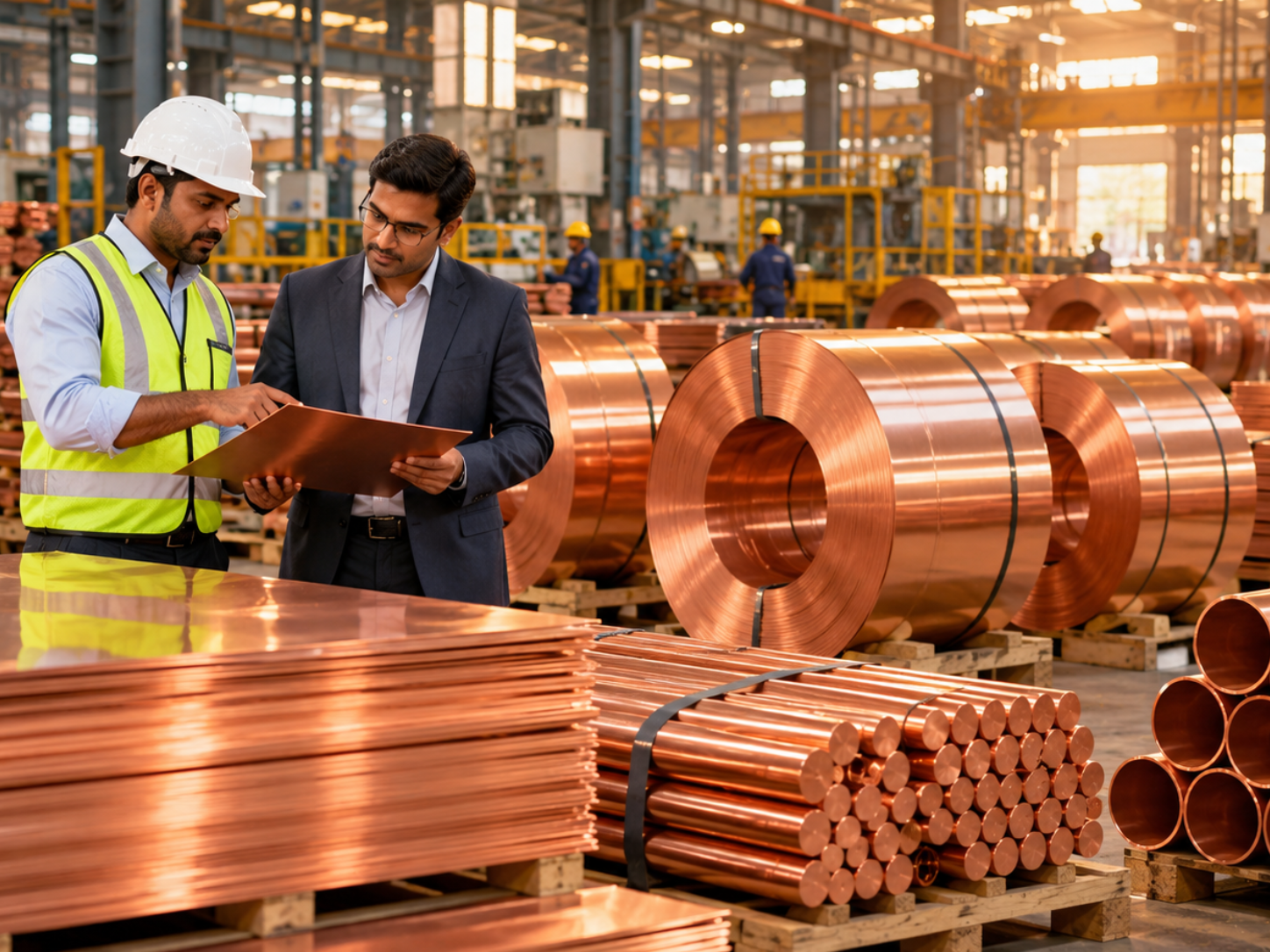
To compare copper manufacturers in India, check five things: quality, certifications, production capacity, price and delivery time. A reliable copper manufacturer shares test reports, holds ISO certification and gives clear written quotes. Industrial copper products, copper rods and strips, grades, and bulk supplies are all covered in this book. Use it as a simple buyer checklist.
What Quality Standards Should a Copper Manufacturer Meet?
A good copper manufacturer follows BIS (Bureau of Indian Standards) rules for purity, size, strength and conductivity. You should check for IS 191, IS 613 and IS 1897. These standards cover refined copper, rods and strips. They help every batch perform the same way in your wiring, machinery or transformer work.
How a copper manufacturing company makes quality copper:
- In a furnace, the group melts pure cathode copper.
- They cast the molten copper into billets or continuous rods.
- They roll or draw the billets into rods, sheets and strips.
- They anneal the copper. This heat step makes it soft and easy to bend.
- The lab tests every batch for purity, size and conductivity before dispatch.
Ask your supplier for these test reports. A trusted manufacturer shares them without delay.
Which Copper Grades Does a Copper Manufacturer Offer for Industrial Use?
A copper manufacturer usually offers three industrial grades: ETP, OFC and DHP. ETP suits electrical wiring and power distribution. DHP suits roofing, pipes and plumbing. OFC suits high-end electronics and vacuum devices. Choose your grade based on your end use, not on price alone.
Copper grades, purity and common use:
|
Copper Grade |
Purity |
Common Use |
|
ETP (C11000) |
99.90% min |
Copper for Electrical Wiring and Power Distribution, busbars, transformer strips |
|
OFC (C10200) |
99.95% min |
Electronics, audio cables, vacuum devices |
|
DHP (C12200) |
99.90% min |
Copper Sheets for Roofing and Construction, pipes, heat exchangers |
|
Cathode |
99.99% |
Raw material that manufacturers melt to make rods, sheets and strips |
What each grade means for you:
- ETP (Electrolytic Tough Pitch): This grade gives you about 100% IACS conductivity. For electrical work, it is the ideal choice.
- OFC (Oxygen-Free Copper): This grade has almost no oxygen. It conducts well and stays clean in delicate equipment.
- DHP (Deoxidised High Phosphorus): This grade has a little phosphorus added. It welds and brazes easily, so plumbers and roofers prefer it.
Key properties of industrial copper:
- It carries electric current better than most metals.
- It resists rust and corrosion.
- It does not crack as it bends, rolls, or draws into thin shapes.
- It moves heat quickly, so it works well in heat exchangers.
- You can recycle it again and again without losing quality.
Tell your supplier your exact use. A good manufacturer will suggest the right grade and share a test report with it.
How to Check Copper Purity and Product Quality Before Buying?
To check copper purity, ask your copper manufacturer for a mill test certificate (MTC) and a spectro report. Check the conductivity value. Before placing a complete order, try a sample. A trusted supplier shares these results openly and answers your questions without delay.
Documents to ask for:
- Mill test certificate (MTC): This paper shows the chemical makeup and test results of your lot.
- Spectro report: A machine reads the metal and shows the exact copper percentage.
What to check on the copper:
- Purity: Look for 99.9% or more for electrical use.
- Conductivity: Look for around 100% IACS. This score shows how well copper carries current compared to a standard.
- Size and weight: Measure thickness, width and weight against your order.
- Surface: Look for a smooth finish. You should see no cracks, dents or green spots.
For large orders:
- Request a sample from the same batch.
- Send it to a third-party lab, such as an NABL-accredited one.
- Compare the lab result with the supplier’s report.
- Place your full order only when both match.
What Copper Products Should a Manufacturer Offer for Bulk Supply?
A good copper manufacturer should offer copper rods, strips, sheets, wires and busbars in bulk. Each product does a different job. When you buy them from one place, you save time and freight. Also ask about ready-stock sizes and bulk packing before you order.
Products you should look for:
- Copper Rods for Electrical and Engineering Applications: Industries use them for connectors, terminals and machine parts.
- Copper Strips for Transformer Manufacturing: Transformer makers use them for windings and busbars.
- Copper Sheets for Roofing and Construction: Builders use them for roofs, cladding and decor.
- Copper Components for Industrial Machinery: Factories use them where heat and current must move fast.
Ask your supplier these questions:
- Which sizes do you keep in ready stock?
- What is your minimum order quantity?
- How do you pack coils, sheets and rods for transport?
Need copper rods, sheets or strips in bulk? Talk to our team.
How to Compare Prices from Different Copper Manufacturer?
To compare copper prices, look at the full cost, not just the rate per kg. Ask each copper manufacturer for a quote in the same format. Copper prices follow the market, so rates change often. Add making charges, GST, freight and payment terms to every quote before you decide.
What to include in every quote:
- Base rate: The price per kg, linked to the day’s market rate.
- Making charges: The extra cost to turn copper into rods, sheets or strips.
- GST: Add it to every quote so all rates match.
- Freight: The cost to move the copper to your site.
- Packing: Check if the rate covers coils, pallets or wooden boxes.
What to ask each supplier:
- How long is the quote valid?
- Is the rate fixed or linked to the market?
- What are the payment terms?
- Do you give a discount on larger orders?
How to compare quotes:
- Ask for written quotes from at least three suppliers.
- Put all costs side by side, including GST and freight.
- Check that the grade, purity and size are the same in each quote.
- Match each price with the test report.
Do not pick only the lowest price. A very low rate can mean lower purity or missing charges.
A trusted copper manufacturer in India for bulk orders gives you clear, written rates with no hidden costs.
Which Quality Certifications Should a Copper Manufacturer Provide?
A reliable copper manufacturer should hold ISO 9001:2015 for quality systems. It should also share test reports that match BIS standards, with a mill test certificate for each lot. ISO 14001 and RoHS compliance are a plus. Always ask to see the original papers.
Certificates to look for:
- ISO 9001:2015: This shows the company follows a proper quality system.
- ISO 14001: This shows the company manages its impact on the environment.
- RoHS compliance: This shows the copper is free from restricted harmful substances.
- Mill test certificate (MTC): This is proof of purity for each lot.
How to verify certificates:
- Ask for the original certificate, not a photocopy.
- Check the validity date.
- Check that the company name and address match your supplier.
- Match the lot number on the MTC with your delivery.
How to Evaluate a Copper Manufacturer’s Production Capacity?
To judge production capacity, ask for the monthly output in tonnes. Check the furnaces, rolling mills and drawing lines. Capacity shows whether the company can finish your bulk order on time. Bigger is not always better. The plant only has to match your volume.
What to check:
- Monthly output: Ask how many tonnes the plant makes each month.
- Machines: Check the furnaces, rolling mills and drawing lines.
- In-house testing: A plant with its own lab finds problems faster.
- Backup machines: These keep your order moving if one machine stops.
How to verify capacity:
- Visit the plant or ask for a video tour.
- Ask about the largest order the team has handled.
- Ask for names of industries it supplies.
- Compare the plant’s monthly output with your order size.
What Factors Affect Bulk Copper Supply and Delivery Time?
Bulk copper supply depends on raw material stock, copper price swings, order size, production schedule and distance. Ready-stock sizes usually ship in 3 to 7 days. Custom orders often take 2 to 4 weeks. Plan early so your project does not face delays.
Factors that affect supply and delivery:
- Raw material stock: Your supplier needs enough cathode copper in hand. Low stock slows your order.
- Copper price swings: Rates change with the market. A sudden jump can delay quotes and approvals.
- Order size: Large orders need more melting, rolling and testing time.
- Production schedule: A busy plant may take longer to start your order.
- Distance: A far site means more transit days and higher freight.
How to avoid delays:
- Confirm ready stock before you place the order.
- Ask how the supplier packs and ships coils, sheets and rods.
- Lock the rate and the delivery date together in writing.
- Share your size, grade and quantity early.
- Ask for dispatch updates once the order leaves the plant.
A bulk copper material supplier for electrical industries should share a clear delivery plan. It should also tell you the real timeline before you pay.
How to Compare Custom Copper Manufacturing Capabilities?
Custom copper manufacturing means making sizes, shapes and tempers to your drawing. Check if your copper manufacturer can cut, slit, roll and draw copper to your needs. Strong custom skills matter when your machine parts need an exact fit.
What to check:
- Thickness and width range: Ask for the smallest and largest sizes the unit can make.
- Temper: This means the hardness level. Soft copper bends easily. Hard copper holds its shape.
- Cut-to-length service: Ask if the team can cut rods, strips and sheets to your size.
- Tinning or plating: This is a thin coating of tin or another metal. It protects copper from rust and helps in soldering.
- Minimum order quantity: Ask how many kg or tonnes you must order for custom sizes.
How to compare custom capabilities:
- Share your drawing with each supplier.
- Ask if they can make it in-house or send it out.
- Ask for a sample piece before the full order.
- Check the size, temper and finish on the sample.
- Compare lead time and cost across suppliers.
A good manufacturer tells you what it can and cannot make before you place your order.
What to Check Before Choosing a Copper Manufacturer for Bulk Orders?
Check quality, certification, capacity, price and delivery before you choose a copper manufacturer for bulk orders. Pick the one that scores well on all five, not just price. Add trusted names like Disha Enterprise to your shortlist. Compare each one the same way, using proof, not claims.
|
Check |
What to Look For |
|
Quality |
99.9%+ purity, test report, clean finish |
|
Certification |
ISO 9001:2015, BIS-matched reports, MTC |
|
Capacity |
Monthly tonnes, modern machines, in-house lab |
|
Price |
Clear quote with all charges and validity |
|
Delivery |
3 to 7 days for stock, 2 to 4 weeks for custom |
How to judge if a supplier is trustworthy:
- Experience: Check how long the company has been in business.
- Expertise: Check if the team explains grades, tempers and purity in simple words.
- Authority: Look for ISO certificates and IS-compliant products.
- Trust: Check for a real address, phone number, email and written quotes.
Why Disha Enterprise is a trustworthy Manufacturer and supplier of Copper
- Experience: Disha Enterprise has supplied electrical products since 2019. It serves clients across India in the electrical, construction and industrial sectors.
- Expertise: The team makes copper strips, copper plates and copper wire. It also makes GI earthing products and cable trays. It offers custom sizes too.
- Authority: Disha Enterprise is ISO-certified and makes IS-compliant products. It tests every product before dispatch. Ask to see the certificates before you order.
- Trust: Disha Enterprise lists its office at Lohar Chawl, Mumbai - 400002. It shares its phone number, email and business hours, Monday to Saturday, 9:30 AM to 7:00 PM. You can call or WhatsApp the team for a quote.
Before you place the order:
- Shortlist three suppliers, such as Disha Enterprise and two others.
- Ask each one for certificates, test reports and a written quote.
- Request samples from the top two.
- Test the samples and compare the reports.
- Order from the supplier that scores best on all five checks.
Looking for a trusted copper products supplier in India? Suppliers like Disha Enterprise are a good name to shortlist. Ask for samples and test reports first, so you can check before you buy.
Get a free quote.
FAQs
1. Which copper grade is best for electrical wiring?
ETP copper is the common choice. It has 99.9% purity and high conductivity. It works well for wiring and power distribution.
2. How do I know the copper is pure?
Ask for a mill test certificate and a spectro report. Test a sample before you place a bulk order.
3. What is the usual delivery time for bulk copper?
Ready-stock items ship in 3 to 7 days. Custom orders take about 2 to 4 weeks.
4. Can a copper manufacturer make custom sizes?
Yes. Share your drawing, thickness and temper. A good manufacturer will confirm what it can make.
Ready to Order?
Get a free quote. Or talk to our experts.